
Chemical drum materials are often corrosive, hazardous, and subject to strict regulatory requirements. Therefore, companies must ensure that every container can be accurately identified, tracked, and managed throughout its lifecycle.
However, traditional tracking methods such as barcodes and manual records often fail in these demanding environments. Labels may be damaged by chemicals, and manual processes are slow and error-prone. As a result, many companies are now adopting RFID in the chemical industry to improve visibility, efficiency, and compliance.
Before exploring the RFID solution, it is important to understand the limitations of conventional methods.
1. First, labels are easily damaged in harsh environments. Chemical exposure, high temperatures, and physical wear can quickly degrade barcode labels, making them unreadable and unreliable.
2. Second, manual data collection leads to inefficiency and errors. Workers must scan items one by one or record data manually, which increases labor time and the risk of incorrect entries.
3. In addition, there is often a lack of full lifecycle traceability. Traditional systems may capture data at certain points, but they cannot provide continuous tracking from production to storage and transportation.
4. Finally, companies face strict compliance requirements. Regulations related to environmental protection and hazardous materials demand accurate and complete records. Without a reliable chemical traceability system, businesses may struggle to meet audit and safety standards.What Is RFID and Why It Fits Chemical Environments
To solve these challenges, RFID technology offers a more advanced and reliable solution. RFID, or Radio Frequency Identification, uses radio waves to automatically identify and track tagged objects. A standard RFID tracking system includes tags, readers, and a data management platform.
Unlike barcodes, RFID does not require direct line-of-sight scanning. This allows data to be captured even when containers are stacked or moving. Moreover, RFID supports fast and batch reading, which improves efficiency in busy industrial environments.
Most importantly, RFID systems can be designed with industrial-grade components, making them suitable for chemical environments where durability and stability are essential.
With these advantages, RFID can be applied to chemical drum management through a structured solution.
1. First, corrosion-resistant RFID tags are used to label each drum. These tags typically meet IP67 or higher protection standards, allowing them to withstand chemicals, moisture, and high temperatures. Each tag stores key information such as drum ID, material type, batch number, and hazard classification. This creates a unique “one drum, one ID” system.
2. Next, during the filling process, data is written into the RFID tag, establishing a digital identity for each container. This step ensures that all relevant production information is linked directly to the physical drum.
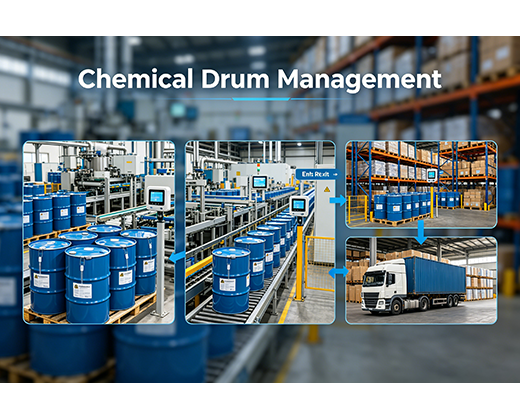
3. After that, RFID readers are deployed across the production line, warehouse, and transportation stages. These devices automatically capture data whenever a drum passes through key points, such as entry/exit gates or storage areas. This enables real-time asset tracking without manual input.
As a result, companies can monitor the movement and status of each drum across the entire supply chain, improving both efficiency and control.
One of the most important benefits of RFID is its ability to support full lifecycle traceability.
With continuous data collection, every stage of the drum’s journey is recorded, from production and storage to transportation and delivery. This creates a complete and reliable digital record that cannot be easily altered.
In case of quality issues or safety incidents, companies can quickly identify the affected batch and trace it back to its source. This improves response speed and reduces potential risks.
Furthermore, RFID systems help companies meet regulatory requirements by providing accurate and accessible data. This makes audits more efficient and supports compliance with environmental and safety standards. A well-designed RFID traceability system is therefore essential for modern chemical operations.
With RFID in place, chemical companies can achieve several operational improvements.
1. First, safety management is enhanced. By reducing manual processes and improving data accuracy, the risk of human error is minimized.
2. Second, operational efficiency increases. Automated identification speeds up processes such as inventory checks, loading, and unloading.
3. Third, inventory visibility improves. Managers can access real-time information about the location and status of each drum, enabling better decision-making.
4. Finally, compliance becomes easier to manage. With complete and accurate data records, companies can respond quickly to audits and regulatory checks. These benefits demonstrate the value of RFID as an industrial tracking solution.
In addition to standalone benefits, RFID can be integrated with warehouse management systems (WMS) and enterprise resource planning (ERP) platforms.
Through this integration, data from RFID systems can be shared across departments, improving coordination between production, storage, and logistics.
This also enables advanced data analysis, helping companies optimize operations and reduce costs. As part of a smart supply chain, RFID plays a key role in digital transformation.
To ensure successful deployment, several factors should be considered.
First, selecting the right RFID tags is essential. Tags must be durable and suitable for chemical exposure and extreme conditions.
Second, reader placement should be carefully planned to ensure accurate data capture across all key points.
Finally, system compatibility and data security should be addressed. A reliable RFID solution provider can help design a system that meets both operational and regulatory requirements.
In conclusion, RFID technology provides a practical and effective solution for chemical drum management. By enabling real-time tracking, automated data collection, and full lifecycle traceability, RFID helps companies overcome the limitations of traditional methods.
As the chemical industry continues to evolve, adopting advanced technologies like RFID is essential for improving safety, efficiency, and compliance.
If your business is looking to enhance chemical drum tracking, improve operational visibility, and meet strict regulatory requirements, ZD Technology offers professional RFID solutions tailored to industrial environments. Our team can help you design and implement a reliable RFID tracking system that supports safer and more efficient operations.
Contact ZD Technology today to learn how RFID can transform your chemical supply chain management.
Do you need a professional team to provide you with solutions? Contact us for a quote
Let us discuss it with you.


 Tel: +86-755-23080267
 Email: sales1@zd-technology.com
Add: A316,building A, Huayuan Technology And Innovation Park, Baoyuan Road
Copyright © 2024 Shenzhen ZD Technology Co., Ltd., All rights reserved.
Designed by 

