
In modern warehouses, speed and accuracy are critical to maintaining smooth operations. However, many companies still struggle with one basic task—finding the right item quickly. In environments with thousands of SKUs and dense shelving, manual searching often slows down the entire workflow.
Traditionally, warehouse staff rely on experience, printed lists, or barcode systems to locate goods. While these methods can work, they are often inefficient and prone to errors. As a result, delays, incorrect shipments, and increased labor costs become common problems.
To address these challenges, RFID warehouse management systems are introducing a new approach known as the “goods-to-person” model. Instead of employees searching for items, RFID technology allows goods to “guide” workers directly to their location, significantly improving efficiency and accuracy.
Before exploring the solution, it is important to understand the key limitations of traditional warehouse operations.
First, low picking efficiency is a major issue. In large warehouses, finding a single item can take 10 to 20 minutes, especially for new or unfamiliar staff. During peak seasons, this delay directly impacts order fulfillment speed.
Second, high error rates are difficult to avoid. Workers may confuse similar items or miss certain products, leading to incorrect shipments or incomplete orders. These mistakes often result in additional costs, returns, and customer dissatisfaction.
Another challenge is the long training cycle for new employees. Since traditional systems depend on memory and familiarity with warehouse layouts, new staff require significant time to become fully productive.
Finally, there is often a lack of real-time inventory visibility. Without accurate location data, warehouse managers cannot track items efficiently, which further reduces operational efficiency. These issues highlight the need for a more advanced inventory tracking solution.
To overcome these challenges, many companies are turning to RFID technology in warehouse operations. RFID, or Radio Frequency Identification, uses radio waves to automatically identify and track objects. A typical RFID tracking system includes tags, readers, and software for data processing.
Unlike barcode systems, RFID does not require line-of-sight scanning. This means items can be identified even if they are inside boxes or behind other objects. In addition, RFID supports batch reading, allowing multiple items to be scanned at the same time.
Because of these features, RFID is well suited for complex warehouse environments where speed, flexibility, and accuracy are essential.
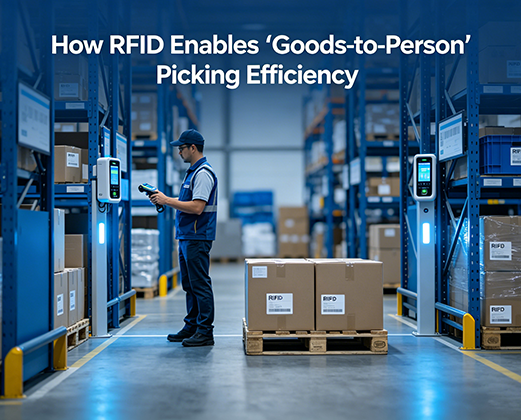
With RFID in place, warehouses can shift from manual searching to a more automated and guided process.
First, each item or pallet is equipped with an RFID tag that stores important information such as SKU, product name, and storage location. This creates a digital identity for every item in the warehouse.
Next, RFID readers are installed at key points, such as shelves, aisles, and entry/exit areas. Workers may also use handheld readers to assist with daily tasks. These devices continuously collect data and update the system in real time.
When a worker needs to pick an item, they simply enter the SKU into a handheld device or system interface. The RFID picking system then provides clear navigation instructions, guiding the worker directly to the correct location.
As the worker approaches the target area, additional indicators, such as lights or signals, can highlight the exact position of the item. This ensures accurate picking and reduces the risk of mistakes.
Through this process, RFID enables a true goods-to-person system, where information leads the worker instead of relying on memory or manual searching.
By implementing RFID-based picking, warehouses can achieve several important improvements.
First, picking efficiency increases significantly. Tasks that previously took 10–20 minutes can now be completed in just a few minutes. This allows workers to handle more orders in less time.
Second, accuracy improves greatly. With system-guided picking and clear location indicators, the chances of selecting the wrong item are greatly reduced. This helps lower return rates and improve customer satisfaction.
Third, employee onboarding becomes faster. New workers do not need to memorize warehouse layouts. Instead, they can rely on the system for guidance and become productive much more quickly.
Finally, picking routes can be optimized automatically. The system can plan the most efficient path for collecting multiple items, reducing unnecessary movement and improving overall workflow efficiency. These benefits make RFID a powerful tool for warehouse efficiency improvement.
Beyond standalone use, RFID can be integrated with existing warehouse management systems. This integration allows real-time synchronization of inventory data, improving decision-making and operational control.
For example, managers can monitor stock levels, track item movement, and analyze performance data more effectively. As a result, the warehouse becomes more responsive and better aligned with business needs.
This combination of RFID and WMS integration supports the development of smarter and more efficient warehouse systems.
When adopting RFID, companies should choose a solution that matches their warehouse size and operational needs.
For small warehouses, a simple setup using RFID tags and handheld readers may be sufficient. This approach provides basic tracking and improves picking efficiency with a relatively low investment.
For medium and large warehouses, a more advanced system can be implemented. This includes fixed readers, handheld devices, and visual indicators, along with full system integration. Such solutions provide comprehensive tracking and optimization capabilities.
In specialized environments, such as cold storage or pharmaceutical warehouses, RFID systems can be customized with durable tags and environmental sensors to ensure reliable performance. Choosing the right RFID solution provider is essential for successful implementation.
In conclusion, RFID technology is transforming warehouse operations by changing how items are located and managed. By enabling real-time tracking and system-guided navigation, RFID eliminates many of the inefficiencies associated with manual picking.
As warehouses continue to grow in size and complexity, adopting a goods-to-person system becomes increasingly important for maintaining efficiency and accuracy. RFID provides a practical and scalable solution to meet these demands.
If your business is looking to improve warehouse picking efficiency, reduce errors, and enhance inventory visibility, ZD Technology offers professional RFID solutions tailored to your needs. Our team can help you implement a reliable RFID warehouse management system that supports smarter and more efficient operations.
Contact ZD Technology today to discover how RFID can transform your warehouse and drive better performance.
Do you need a professional team to provide you with solutions? Contact us for a quote
Let us discuss it with you.


 Tel: +86-755-23080267
 Email: sales1@zd-technology.com
Add: A316,building A, Huayuan Technology And Innovation Park, Baoyuan Road
Copyright © 2024 Shenzhen ZD Technology Co., Ltd., All rights reserved.
Designed by 

