
A B2B buyer guide to tag selection, lane design, and scalable vehicle credentialing
For parking operators, campuses, logistics yards, and fleet managers, RFID windshield tags can turn a vehicle into a hands-free credential. ZD RFID vehicle-management solutions combine tags, readers, antennas, and system logic to identify enrolled vehicles at controlled entry and exit lanes.
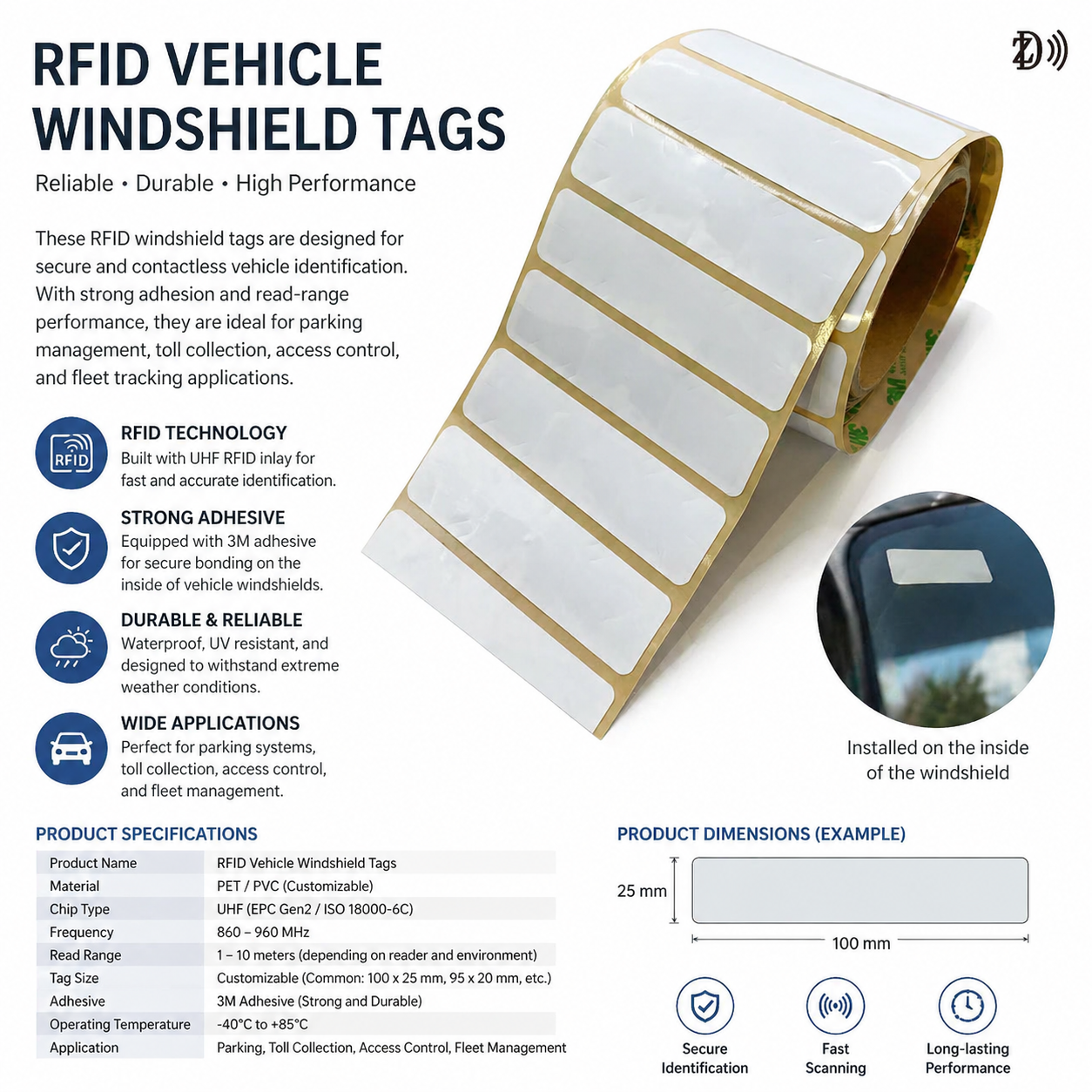
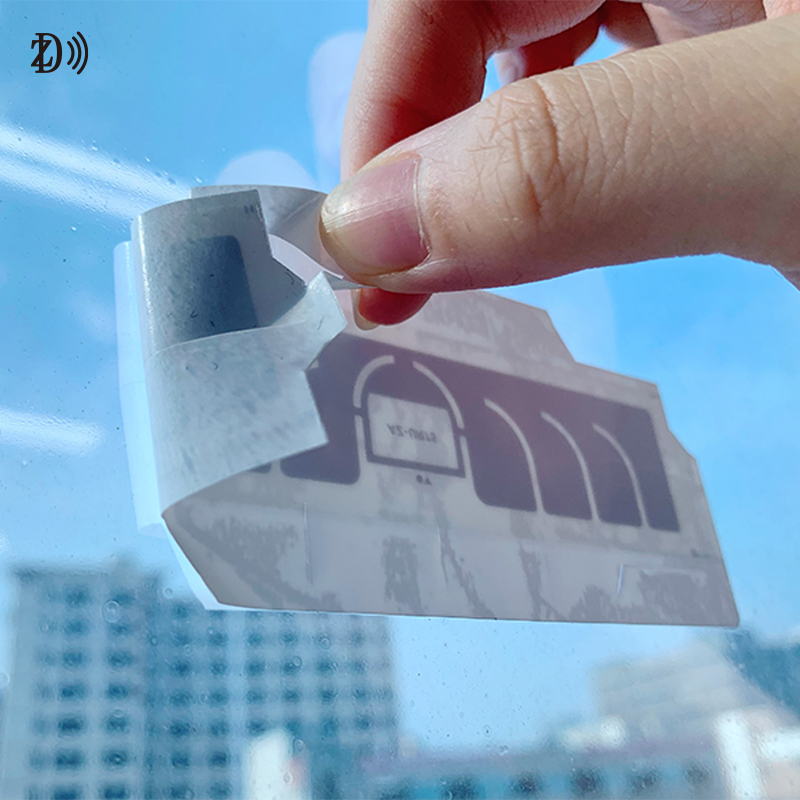
A passive UHF windshield tag is an adhesive label placed inside a vehicle windshield. When the vehicle enters a defined read zone, a fixed reader and antenna interrogate the tag and pass its identifier—commonly an EPC or serial number—to the access-control, parking, visitor, or fleet platform. The platform decides whether to open a barrier, record an event, or route the vehicle for an exception check.
The tag is a credential, not proof that a particular driver or vehicle is authorized on its own. Effective deployments link the identifier to current permit rules and use revocation, replacement, and exception procedures. For higher-assurance lanes, RFID can be paired with license-plate recognition or cameras for visual verification and investigation.
The business case is usually operational rather than simply “long read range.” A vehicle credential can be associated with a tenant, driver, delivery slot, contract, work order, or permit tier. This helps reduce manual gate checks while producing cleaner arrival, departure, occupancy, and exception records.
· Parking and property operators can manage resident, employee, visitor, and contractor permissions without issuing a handheld card at every entry.
· Fleet and yard teams can confirm that enrolled vehicles reach the correct gate, service bay, or loading area before a workflow is released.
· Security teams can blacklist lost, cancelled, or expired credentials in the backend and retain an event trail for review.
· Procurement teams can standardize printed identifiers, encoding files, packaging, and installation instructions across multi-site rollouts.
Read performance is a system outcome. Tag orientation, windshield construction, reader settings, antenna polarization, mounting position, approach angle, vehicle speed, lane width, nearby vehicles, and barrier timing all matter. A tightly controlled read zone in one lane is usually more valuable than an uncontrolled read that also captures tags in adjacent traffic.
Start with representative vehicles. Metallic tint, heated glass, embedded coatings, and unusual windshield geometry can attenuate UHF performance. Test the intended tag position on the actual vehicle mix before committing to a production run. The pilot should measure successful reads, side-lane isolation, barrier response time, failed-read handling, and replacement-tag procedures—not only the longest observed distance.
For reader and antenna planning, review ZD RFID RFID hardware options and coordinate the installation with the access-control integrator.
A windshield label is normally a passive UHF RFID product built for the selected frequency band and target read zone. Common procurement options include PET or paper face materials, permanent adhesive, visible numbering, barcode or QR backup, custom printing, serialized EPC encoding, and roll packaging. Confirm the actual construction, environmental exposure, and application surface with the supplier; a label intended for interior glass should not be described as permanently weatherproof without a validated specification.
Chip selection should follow required memory, identifier handling, reader compatibility, and the tested inlay performance in the chosen windshield construction. Examples offered for vehicle-label configurations include Alien Higgs™-3, Alien Higgs™-4, Impinj Monza® R6, Impinj Monza® R6-P, Impinj M730™, Impinj M750™, NXP UCODE® 8, and NXP UCODE® 9. Product names are trademarks of their respective owners. Availability and final chip choice should be confirmed against the approved bill of materials and pilot results.
Do not treat a static EPC as encryption or as an anti-cloning guarantee. Where a site requires stronger controls, define the complete credential policy: secure encoding where supported, backend authorization, blacklist timing, tag replacement approval, visual inspection, and any complementary camera or plate-recognition workflow. Tamper-evident constructions can provide evidence of removal, but they should be validated for the application and not presented as absolute transfer prevention.
· Vehicle mix and windshield types, including metallic tint, heating elements, and any restricted placement zones.
· Lane layout, antenna position, desired read zone, expected vehicle speed, and adjacent-lane separation requirements.
· Reader, antenna, controller, barrier, and software integration details, including the required identifier format and event interface.
· Tag construction, branding, print data, EPC encoding sequence, duplicate-ID controls, roll quantity, and installation workflow.
· Acceptance criteria for the pilot: read reliability, false/adjacent reads, response time, exceptions, lost-tag replacement, and deactivation.
Often yes, but placement and inlay selection may need to change. Test representative vehicles and the installed lane hardware before specifying a rollout. A supplier’s nominal read range is not a substitute for an on-site pilot.
Standard adhesive labels are generally assigned to one vehicle. If a tag is removed or a vehicle changes, use a controlled replacement process and disable the prior identifier. A tamper-evident option may help reveal removal, subject to the verified construction and surface.
It can be used independently where the risk model permits. In many professional deployments, RFID provides a dependable credential identifier while license-plate recognition or cameras provide visual verification and support exception handling.
Provide a lane drawing or photos, reader and antenna details, target read zone, vehicle and windshield types, monthly quantity, required print and encoding data, and the intended software or controller interface. This makes it possible to recommend samples and a realistic test plan.
Planning a parking, gate, or fleet-access project? Contact ZD RFID with your lane layout, vehicle mix, target read zone, reader model, monthly volume, and encoding requirements. The team can help align samples, tag construction, and hardware choices before a volume order. You can also explore vehicle tracking windshield RFID UHF stickers for a related product starting point.
<
Do you need a professional team to provide you with solutions? Contact us for a quote
Let us discuss it with you.


 Tel: +86-755-23080267
 Email: sales1@zd-technology.com

Add: A316,building A, Huayuan Technology And Innovation Park, Baoyuan Road
Copyright © 2024 Shenzhen ZD Technology Co., Ltd., All rights reserved.
Designed by 

