
In modern healthcare systems, medication safety and availability directly affect patient outcomes. Hospitals and pharmacies manage thousands of drug types, each with strict requirements for batch control, expiration dates, and regulatory compliance. However, as medication varieties increase and treatment cycles shorten, traditional inventory management methods are struggling to keep up.
Against this background, RFID (Radio Frequency Identification) technology has become a practical and proven tool for upgrading medication inventory management. By enabling contactless, batch-level identification and real-time data capture, RFID medication tracking systems help hospitals move from labor-intensive processes to intelligent, data-driven operations. This article explains how RFID is applied in hospital and pharmacy medication inventories, how it works, and what real value it delivers in daily operations.

Before understanding the value of RFID, it is important to examine the limitations of conventional medication management methods used in many hospitals today.
Traditionally, pharmacies rely on barcode scanning or manual recording to count and verify medications. While barcodes improved efficiency compared to handwritten logs, they still require line-of-sight scanning and individual handling. In large hospitals, a full inventory count may take several days, occupying pharmacists and nurses who should be focused on patient care. Human errors, such as missed scans or incorrect entries, further reduce accuracy.
Another major issue is delayed inventory data. Many systems only update after periodic counts, which means inventory records often do not reflect actual stock levels. This leads to situations where essential drugs appear available in the system but cannot be found physically, while other medications expire unnoticed on shelves.
Hospitals must comply with strict regulations related to drug safety, traceability, and controlled substances. Managing expiration dates, batch recalls, and high-value or narcotic drugs is particularly challenging with fragmented systems. During audits or recalls, manual record checks slow response times and increase compliance risks.
RFID technology addresses these challenges by changing how medications are identified, tracked, and managed throughout their lifecycle.
At the core of the system are RFID labels, often called electronic IDs. Each RFID label contains a microchip and antenna that store a unique identification number. This ID can be linked to key information such as drug name, batch number, expiration date, and storage location. Passive RFID labels are commonly used in healthcare because they do not require batteries and have long service lives.
RFID readers communicate with tags using radio waves. Unlike barcodes, RFID does not require direct alignment or individual scanning. Fixed readers installed at warehouse entrances or pharmacy shelves can read hundreds of tags at once, while handheld readers allow staff to locate specific medications quickly.
All RFID data is transmitted to a central software platform that integrates with existing hospital systems such as HIS or pharmacy management systems. This platform provides real-time dashboards, automated alerts, and detailed reports that support decision-making and compliance.
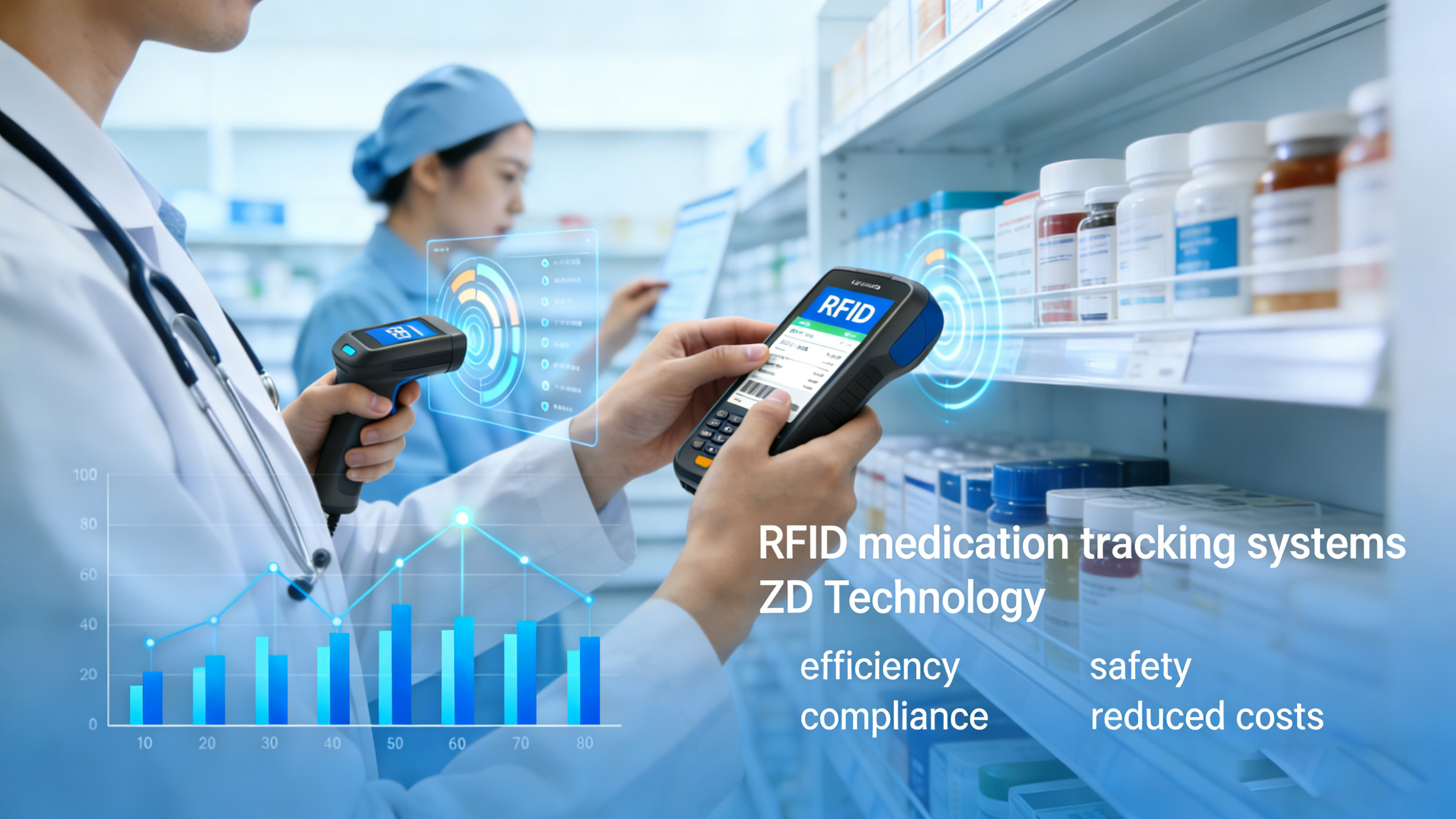
RFID technology supports medication management from the moment drugs enter the hospital to their final use.
When medications arrive from suppliers, RFID-enabled receiving allows entire cartons to be scanned within seconds. The system automatically verifies quantities, batch numbers, and expiration dates, reducing manual checks and preventing data entry errors. This process also supports anti-counterfeiting by ensuring only verified products enter the system.
Inside the pharmacy or central warehouse, RFID provides real-time inventory visibility. Smart shelving and fixed readers continuously monitor stock levels and locations. When staff search for a specific medication, handheld readers guide them directly to the correct shelf or bin, eliminating time wasted on manual searching.
RFID systems automatically track expiration dates and support First-In, First-Out (FIFO) rules. Medications nearing expiry are flagged in advance, allowing staff to prioritize their use or return them before they become waste. This significantly reduces drug losses and improves cost control.
At dispensing points, RFID verifies that the correct medication is issued according to prescriptions. In operating rooms and high-risk departments, RFID tracks the use of high-value drugs and consumables, creating a closed-loop record that improves accountability and patient safety.
RFID also enhances security. When integrated with access control systems, RFID can detect unauthorized movement of medications and trigger alerts. This is especially valuable for narcotics and psychotropic drugs that require strict oversight.
Implementing RFID medication tracking systems delivers measurable improvements across hospital operations.
RFID dramatically reduces the time required for inventory counts while increasing accuracy. Real-time updates eliminate discrepancies between system records and physical stock.
By preventing overstocking and identifying near-expiry medications early, RFID helps hospitals cut waste and reduce unnecessary purchases.
Accurate tracking and dispensing verification reduce medication errors, ensuring patients receive the right drugs at the right time.
RFID creates complete digital records for each medication, making audits, inspections, and recalls faster and more reliable.
Selecting the appropriate RFID setup is critical for success.
Ultra-high frequency (UHF) RFID is widely used for medication inventory management because of its long read range and fast batch reading, making it ideal for warehouses and bulk handling. High frequency (HF) RFID is better suited for close-range identification, such as individual medicine cabinets or patient wristbands.
Hospitals should consider label size, attachment method, durability, and resistance to interference from liquids or packaging materials. Choosing a reliable RFID tag manufacturer ensures consistent performance in demanding medical environments.
Successful RFID deployment requires careful planning. Hospitals often start with high-value or high-risk medications, run pilot projects, and then expand gradually. Cross-department cooperation between pharmacy, IT, and management teams is essential, as is proper staff training.
RFID medication tracking systems are no longer experimental technologies. They are mature, practical solutions that help hospitals improve efficiency, safety, and compliance while reducing operational costs. By replacing manual processes with real-time visibility and automation, RFID supports the long-term development of intelligent healthcare supply chains.
ZD Technology, as an experienced RFID tag manufacturer, provides reliable RFID labels and customized solutions for hospital and pharmacy medication management. Whether you are upgrading a central pharmacy or building a new RFID-based inventory system, ZD Technology is ready to support your digital transformation. Contact us today to learn how our RFID solutions can help you build a safer, more efficient medication management system.
Do you need a professional team to provide you with solutions? Contact us for a quote
Let us discuss it with you.


 Tel: +86-755-23080267
 Email: sales1@zd-technology.com
Add: A316,building A, Huayuan Technology And Innovation Park, Baoyuan Road
Copyright © 2024 Shenzhen ZD Technology Co., Ltd., All rights reserved.
Designed by 

