
Managing crowd flow and venue payments at high volume music festivals creates tough operational challenges. Long queues at entry gates and slow transaction processing at food vendor booths irritate attendees and cap overall revenue potential. Event organizers turn to custom RFID wristbands to address these bottlenecks, replacing paper tickets and cash with rapid, contactless data transmission.
Integrating these smart wearables helps event production teams secure their perimeters and gather accurate live attendee metrics. This unified deployment drops staffing overhead, prevents credential fraud, and delivers a modern, frictionless experience for festival goers.
Having outlined the main venue management hurdles, it is helpful to look at how these smart bands alter daily gate dynamics.
Replacing ticket scans with automatic RFID checks cuts individual processing times dramatically. Event staff can validate thousands of guests every hour per entry lane without managing paper passes or physical wristband inspection.
Linking digital balances to unique chip IDs encourages attendees to make faster purchases at concessions. Guests simply tap their wristband on payment terminals, which removes the burden of cash management and speeds up vendor queues.
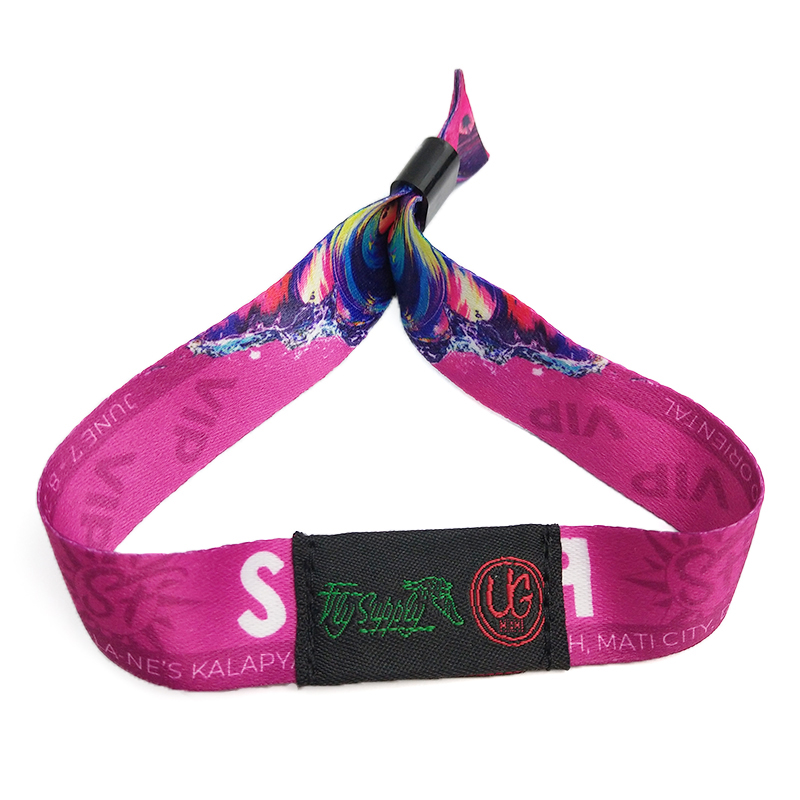
Physical tamper evident closures ensure that guests cannot transfer credentials to unpaid visitors. Each embedded chip carries a unique hardware identification number that pairs with a single guest record in your registration system, making a durable Fabric Wristband an ideal solution for secured event entry.
Moving past gate performance, selecting the right internal hardware specs remains crucial for maintaining stable reading speeds across the venue.
To ensure total hardware compatibility with your access readers, engineering teams must evaluate three essential functional parameters.
| Frequency Band | Operating Range | Data Transfer Speed | Primary Festival Application |
|---|---|---|---|
| High Frequency (13.56 MHz) | 2 cm to 10 cm | Moderate | Cashless Payments and Gate Access |
| Ultra High Frequency (860 to 960 MHz) | 1 meter to 5 meters | High | Vehicle Access and Area Tracking |
High Frequency chips operating at 13.56 MHz serve as the standard choice for close proximity payment terminals and tight access control. Ultra High Frequency systems detect credentials from several meters away, making them useful for tracking crowd movement across wide entry portals.
System success depends on pairing internal microchips like MIFARE Classic® 1K, NTAG® 213, or Impinj Monza series with your chosen gate software. Matching the correct protocol guarantees fast data synchronization between individual wristbands and backend event databases.
Robust aluminum antenna coils keep signal quality consistent even when guests flex their wristbands during use. Suppliers pre encode unique serial numbers and encrypted keys onto individual hardware units prior to event shipping.
Once internal technical parameters are finalized, selecting durable physical strap materials ensures those internal electronics survive harsh festival environments.
Selecting the right strap material keeps attendees comfortable while protecting sensitive internal chips against physical stress.
Soft polyester woven straps remain the primary choice for weekend music festivals due to their durability and skin comfort. Production teams seal internal RFID inlays inside water resistant PVC pods attached directly to the fabric wristbands.
Disposable synthetic paper bands provide a practical solution for single day entry passes or short temporary events. These lightweight straps incorporate tear resistant coatings and security slits around the adhesive closure point to prevent reuse.
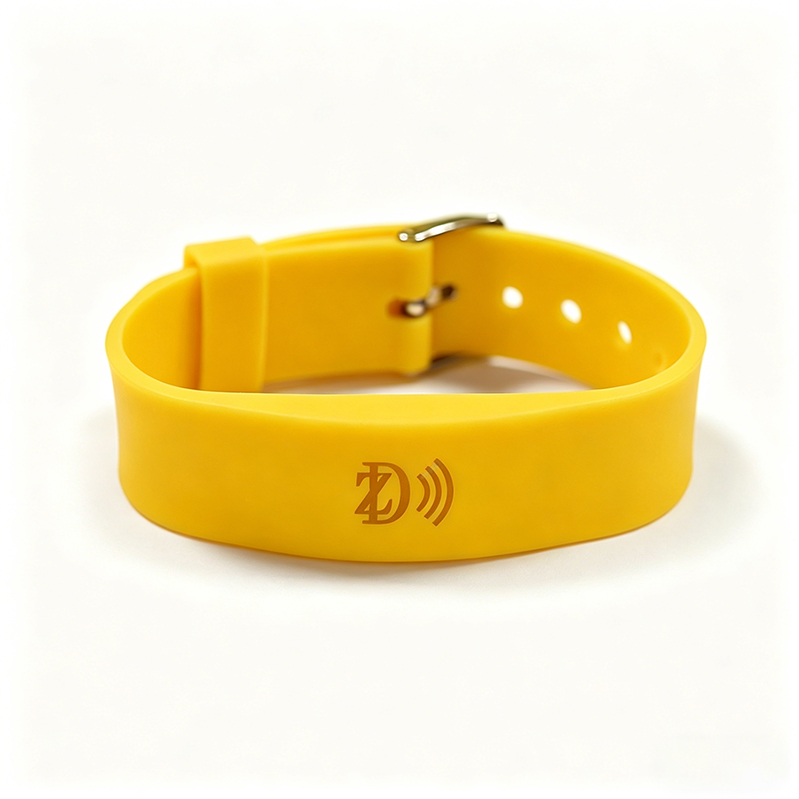
Reusable silicone wristbands work well for staff passes, long term VIP credentials, and venue water parks. Festival organizers seeking eco friendly alternatives can also order recycled PET fabric straps made from post consumer plastics.
After picking the ideal strap material, configuring customized physical security closures helps protect your venue against credential theft.
Combining eye catching graphics with physical security hardware creates an effective visual and digital defense system.
High resolution thermal transfer printing applies clear sponsor logos, custom patterns, and full color artwork directly onto woven fabric surfaces. Laser engraving adds permanent serial numbers to plastic faceplates without damaging underlying antenna circuits.
One way slide locks feature internal teeth that grip fabric threads, allowing staff to tighten the strap while preventing backward movement. Once tightened against the wrist, attendees cannot remove or share the band without cutting the material completely.
Printing readable serial numbers and custom QR codes onto straps gives staff a secondary manual validation method if local hardware readers require maintenance. Matching printed visual numbers to internal digital chip IDs ensures absolute credential integrity.
While reliable physical locks stop credential sharing, maintaining system uptime when local internet drops requires specific technical prep.
Having addressed physical hardware designs, evaluating system stability under tough outdoor conditions represents the final preparation step.
Local network outages pose a real threat to cashless vendor booths during peak operational hours. Selecting reader hardware capable of storing offline transactions ensures payment processing continues without active internet links, syncing data automatically once connectivity returns.
Defective chips cause avoidable bottlenecks at entry gates and frustrate incoming guests. Conducting factory read testing before shipping ensures every batch maintains proper antenna signal strength and error free data encoding.
Large power generators, metal trusses, and heavy audio cables can cause electromagnetic signal interference near main entry gates. Placing reader hardware away from high voltage equipment protects signal clarity during high volume ingress periods.
Standard production and chip encoding take three to five weeks depending on design complexity. Accounting for international shipping and final onsite testing, organizers should finalize artwork and chip specs eight to twelve weeks before gate opening.
Sealed chip pods protect internal electronics against heavy rain, mud, and complete water immersion. Enclosed PVC housings and molded silicone bands achieve IP67 or IP68 ingress protection ratings, ensuring accurate reading in bad weather.
High Frequency and NFC wristbands require close proximity, scanning between two and five centimeters from the reader face. Ultra High Frequency wristbands read from one to three meters away, allowing hands-free gate detection.
Custom RFID wristbands deliver a complete hardware solution for festival access control, cashless payment processing, and credential security. Replacing manual ticket checks and cash handling speeds up venue entry, protects venue revenue, and gives organizers actionable operational data. Choosing the proper frequency specs, durable strap materials, and reliable offline reader workflows guarantees strong performance across demanding outdoor environments.
Implementing robust RFID wearables improves guest entry flow and enhances overall festival operations. Contact our engineering team today to review your technical requirements and configure a tailored RFID deployment for your upcoming event.
Do you need a professional team to provide you with solutions? Contact us for a quote
Let us discuss it with you.


 Tel: +86-755-23080267
 Email: sales1@zd-technology.com
Add: A316,building A, Huayuan Technology And Innovation Park, Baoyuan Road
Copyright © 2024 Shenzhen ZD Technology Co., Ltd., All rights reserved.
Designed by 

